
Nuggets of 8th Pay Commission
Pay Commission is a body established by the Government to review and revise the Salaries and allowances of Government employees. To cite its continuity the 8th Pay Commision was introduced in January, 2025 to ensure fair and equitable remuneration by addressing the issues related to pay disparities and inflation.
Shiwali Srivastava
1/14/20252 min read


Pay Commission is a body established by the Government to review and revise the Salaries and allowances of Government employees. To cite its continuity the 8th Pay Commision was introduced in January, 2025 to ensure fair and equitable remuneration by addressing the issues related to pay disparities and inflation.
वेतन आयोग सरकारी कर्मचारियों के वेतन और भत्तों की समीक्षा और संशोधन करने के लिए सरकार द्वारा स्थापित एक निकाय है। इसकी निरंतरता का हवाला देते हुए वेतन असमानताओं और मुद्रास्फीति से संबंधित मुद्दों को संबोधित करके उचित और न्यायसंगत पारिश्रमिक सुनिश्चित करने के लिए जनवरी, 2025 में 8वां वेतन आयोग पेश किया गया था।
Impact
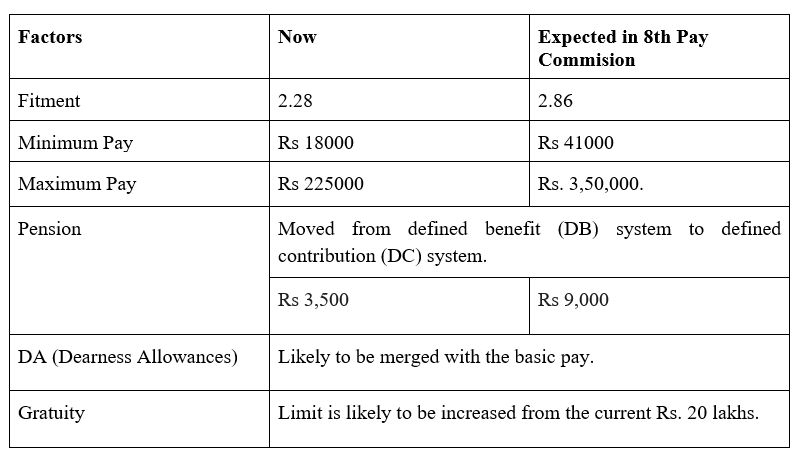
The 8th Pay Commission is likely to have a significant impact on the salaries and pensions of Central Government Employees. The increased Minimum pay, Fitment factor, and HRA rates will lead to a substantial increase in the salaries of employees. The merger of DA with the basic pay and the revision of pension rules will also have a positive impact on the salaries and pensions of employees. The new tax regime may also lead to lower tax outgo for employees.
Challenges ahead
Overall, the implementation of the 8th Pay Commission recommendations represents a complex and multifaceted challenge for the government. It will require a comprehensive and strategic approach that takes into account the financial, economic, and administrative implications. The government will need to demonstrate prudent fiscal management, innovative revenue generation strategies, and effective policy coordination to successfully navigate this challenge and ensure sustainable and equitable development.
Furthermore, the implementation of the 8th Pay Commission recommendations will have a cascading effect on the economy. The increased disposable income of government employees could potentially fuel inflation, which would need to be managed carefully through appropriate monetary and fiscal policies. There is also a risk that the increased government expenditure could lead to a fiscal deficit, which could have adverse implications for the economy in the long run.
In addition to the financial implications, the implementation of the 8th Pay Commission recommendations could also have administrative and logistical challenges. The revision of pay scales and allowances for a vast number of government employees will require meticulous planning and execution to ensure a smooth transition. There is also a need to address potential disparities and anomalies that may arise from the implementation of the new pay structure.
Conclusion
The 8th Pay Commission represents a significant development for central government employees in India. The anticipated changes are wide-ranging and are expected to have a positive impact on their financial stability and overall well-being. While the specific details are yet to be finalized, the overall direction is clear: towards a more equitable and competitive compensation structure for central government employees.
8वां वेतन आयोग भारत में केंद्र सरकार के कर्मचारियों के लिए एक महत्वपूर्ण विकास का प्रतिनिधित्व करता है। प्रत्याशित परिवर्तन व्यापक हैं और उनका उनकी वित्तीय स्थिरता और समग्र कल्याण पर सकारात्मक प्रभाव पड़ने की उम्मीद है। हालांकि विशिष्ट विवरणों को अभी तक अंतिम रूप नहीं दिया गया है, समग्र दिशा स्पष्ट है: केंद्र सरकार के कर्मचारियों के लिए अधिक न्यायसंगत और प्रतिस्पर्धी मुआवजा संरचना की ओर।